- What is the difference between a permanent deacon and a transitional deacon?
- What does a deacon actually do?
- How do I address a Deacon?
So if you’ve ever wondered the above — or weren’t even aware there’s such a thing as a permanent deacon or a transitional deacon — you’re not alone. Here is an explainer on the diaconate, a crucial but often overlooked facet of the Catholic Sacrament of Holy Orders.
First, an important distinction: What’s the difference between a transitional and permanent deacon?
Like many things in the Church, this is a question with both a simple answer and a more nuanced answer.
The simple answer: a transitional deacon is a man who’s on his way to be ordained to the priesthood. As a seminarian, he typically is ordained a deacon a year prior to being ordained to the priesthood.
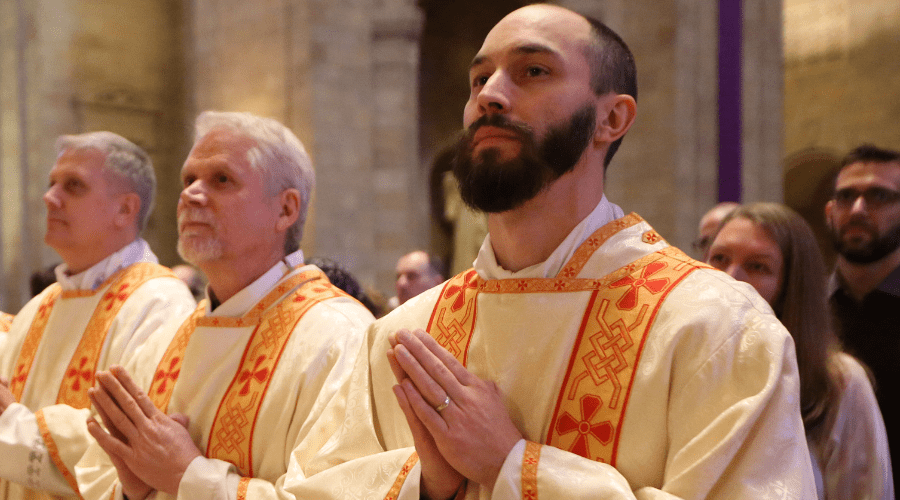
By contrast, a permanent deacon is a man who is not being formed for the priesthood but to be ordained a deacon permanently. Married men may become permanent deacons and have families; they often work in a secular job in addition to their diaconal role.
But it raises another question with a more nuanced answer.
Why even have transitional deacons?
What’s the point?
If a man is making his way toward the priesthood, why must he be ordained a deacon first?
To answer this, we have to understand a little bit about the sacrament of Holy Orders, which has three degrees (think kind of like ranks in the army or titles at your place of business): the diaconate, the priesthood, and the episcopacy.
Although each degree’s role and function has developed over time, all three have been present since the earliest days of the Church.
Bishops have been tasked with sanctifying, governing and teaching; they’re considered to have the “fullness” of holy orders. The priests participate in the bishops’ ministry of ruling and teaching and sanctifying. Both bishops and priests serve in persona Christi capitis, or in the person of Christ, the head.
Deacons, on the other hand, participate in their local bishop’s ministry, but they don’t serve as Christ the head. They serve in persona Christi servi, which means Christ the servant.
During the Second Vatican Council, the Church Council Fathers recognized the need for new ways to proclaim Christ to the world. As the Church continued to develop new strategies, there was something missing, what St. John Paul II called the Church’s service “sacramentalized.”
That is essentially the role of the diaconate.
Pope Paul VI in 1967 reestablished the order of the diaconate as a permanent rank, precisely because there was this indelible character — a mark of service that the Church herself founded on Christ and by Christ is the servant in all that she does.
This is played out even as a man continues to work toward being ordained a priest or, for a few, when he is ordained a bishop.
The bishop will wear a dalmatic – the vestment a deacon wears – underneath his chasuble.
Once a man is ordained a deacon, he always will be a deacon.
OK, so what does a deacon actually do?
The Church defines three main areas of service for the diaconate: ministry of the word, ministry of the liturgy, and ministry of charity.
Ministry of the Word: As Catholics, we believe that Christ Himself is the word of God and comes forth to proclaim the good news. The deacon is the herald of the Gospel, and you can see it at most Sunday Masses: the deacon is the one who proclaims the Gospel.
But it’s not just at Mass that deacons share the good news. A deacon is meant to proclaim the Gospel in every area of his life. All Christians are called to do the same, but deacons do it as part of the sacrament of holy orders.
“This is the sacrifice that’s being offered by the high priest, Christ himself, in the person of the priest, but it is also the ultimate act of service to the Father, and we see this sacramentalized in the person of the deacon.” — Deacon Eric Cooley, Associate Director, Saint Paul Seminary Institute for Diaconate Formation
Ministry of the liturgy: Besides reading the Gospel, a deacon’s assistance at Mass is perhaps the most visible sign of his ministry you’re used to seeing on a regular basis.
But permanent deacons also can baptize, witness marriages and preside at funeral services. In the United States, deacons often conduct word-and-communion services for the homebound or elderly.
“One of my favorite aspects of this is at the end of the Eucharistic Prayer where we have the doxology,” said Deacon Eric Cooley, associate director of The Saint Paul Seminary Institute for Diaconate Formation. “If there’s a deacon at Mass, he holds the chalice while the priest holds the host, as he says the doxology. And this is a beautiful example of how, yes, this is the service, or this is the sacrifice that’s being offered by the high priest, Christ himself, in the person of the priest, but it is also the ultimate act of service to the Father, and we see this sacramentalized in the person of the deacon.”
Ministry of charity: The Eucharist is the source and summit of our faith, but we’re not meant to stay inside the walls of the Church 24/7. The deacon says at the end of the liturgy to “go forth, the Mass has ended.”
Deacons go forth as a servant of Christ to bring charity to the world, each in his own unique way.
Some take part in prison ministry. Others visit the sick in hospitals. Others do different pastoral works within the community of the parish to which they’re assigned.
“This is why you see the deacon as the one that leads the Universal Prayer, gives the intercessions,” Cooley says. “He’s the one that says, ‘These are the needs of the community. Let’s bring them to the Lord.’ And so we see … this ministry of service through these three different ways.”
When greeting Catholic clergy or a member of a religious order, it’s not always apparent how to address them. Depending on the rank of the individual, there are specific forms of address that have been handed down over the centuries.
How do I address a Deacon?
In the Roman Catholic Church, there are two types of deacons: permanent deacons and transitional deacons. Here’s how to address them:
- Permanent Deacons:
- Formal Address in Writing: Use “Deacon” followed by their full name (e.g., “Deacon John Smith”).
- Conversation: Simply address them as “Deacon” followed by their last name (e.g., “Deacon Smith”).
- Transitional Deacons (those on their way to becoming priests):
- Formal Address in Writing: Use “the Reverend Mr.” followed by their full name (e.g., “the Reverend Mr. James Brown”).
- Conversation: Address them as “Deacon” followed by their last name (e.g., “Deacon Brown”). After their priestly ordination, they will be addressed as “Father” followed by their last name1.
Remember that the use of “the Reverend + Mr.” is less common in Canada & the United States. So, whether permanent or transitional, addressing them as “Deacon” followed by their last name is a respectful and appropriate choice. 😊
These forms of address are not intended to puff up Catholic clergy members, but are ways to express respect and honor to a person who has been given a particular role in the Church’s mission. It is a way to show good manners in a world that has generally neglected any sense of public decorum.
At the same time, we shouldn’t be overly stressed out about addressing priests or bishops by their formal titles in all situations. There is a story of a young man at confirmation who accidentally called the bishop, “Father.” Instead of rebuking him, the bishop said to the boy, “Don’t worry, that’s the best title I have ever had.”
 The Deacon Guy
Excellent summary on the meaning and work of Deacons! Thanks for posting this Brother Deacon Côté!
Deacon Guy Dacquay
LikeLike